Latest Posts
View the latest posts in an easy-to-read list format, with filtering options.
View the latest posts in an easy-to-read list format, with filtering options.
Multi-part posts on a particular topic, grouped together in "series" pages.
Look through our blog archive by year / month, or in a massive title list.
10/22/2026 - When a watchman gives warning, he/she should keep in mind the principle in Ephesians 4:15, 15 But... Read More

10/21/2026 - I received this email from our ministry representative in Nepal today. Dear Respected Sir and pray... Read More
10/21/2026 - Ezekiel’s call as a watchman is described beginning in Ezekiel 3:18, 19, 18 When I say to th... Read More
Read over 100 books written by Dr. Jones, available to read for free online. Several of the books have also been translated into different languages, and are also available to read for free. The only time you pay is when you purchase a physical version of a book.
View Full Book List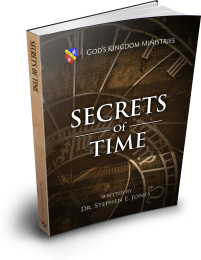

Read a variety of tracts that condense a topic into a short, single page format. These tracts can be read for free online, or physical copies can be purchased in bundles. If you are subscribed to the FFI Newsletter, you will receive new tracts when they are released.
View Full Tract ListJeremiah’s revelation of the transfer of authority to the beast empires was partial, in that he saw only Babylon and its 70-year reign. It took Daniel to complete the revelation, telling us about the rest of the beast empires that were hidden from Jeremiah. But even Daniel’s revelation was partial, requiring John to add further details in Revelation 13.
These are prime examples of what Paul wrote in 1 Corinthians 13:9, “we prophesy in part.” It would be much more convenient and far less confusing if God had simply given the whole picture to a single prophet. But God has chosen to distribute His gifts to the body in order to make us work together as a body, and, likewise, God has chosen to give pieces of revelation to many prophets in order to reward diligence in studying the word as a whole.
By studying the word given to prophets in the past, we can come to know how God thinks, why He does things the way He does, and what His intentions are. He does not always make things easy for us to understand, but if we develop our own gifts and learn to hear His voice, we too can receive revelation supplementing that given to the biblical prophets. Certainly, all of the basic principles of the mind of God have been set forth in the Scriptures already, but many particulars are yet to be known.
Jeremiah received revelation about Babylon, because that was the most relevant thing to know in his lifetime. In the next generation, Daniel was given more, and John was given still more. John’s revelation, in particular, is no longer understood by most Bible teachers, because they have rejected the Historicist view and have adopted the Futurist view of prophecy.
The Reformers in past centuries saw the book of Revelation as a prophecy about church history that filled the information gaps in Daniel’s prophecy. They saw Revelation as a supplement and continuation of Daniel, and that is how I view it as well. Futurists seem to have little knowledge of church history in the past 2,000 years, and for this reason, they are blind to all the prophecies that have already been fulfilled. Likewise, they interpret the book of Revelation too literally and then claim that those events are still future.
However, John saw things in symbolic language reminiscent of the language in the gospel of the stars. All of the stars and constellations were named by God Himself (Psalm 147:4) and prophesied of Christ—His nature, His plan of redemption, and the final judgment.
Virgo reveals the truth that Christ was to be born of a virgin. Its main star is Zimach (Hebrew: Zemach, “The Branch”). Isaiah 4:2 refers to Christ as “The Branch.”
Libra reveals the truth that Christ was to satisfy the law. It is pictured as a blindfolded woman holding balances to weigh evidence and arrive at the truth. But Libra was originally an altar. The two bright stars in Libra are (in Arabic) Zuben al Genubi, “the price which is deficient,” and Zuben al Chemali, “the price which covers.” These reveal the truth that man was deficient in his attempt to pay the price for his own sin, so Christ covered it.
Scorpio reveals the Redeemer’s conflict with the serpent. Its Arabic name is Al aterah, “the wounding of the Coming One.” Its brightest star is Antares, “wounding.”). One of its decans, or associate constellations, is Serpens, the serpent assaulting his heel.
Sagittarius reveals Christ as the great Archer, which is a Hebrew metaphor for a Teacher. Its brightest star is called in Hebrew, Channun, “The Gracious One.”
Capricornus reveals Christ as the goat of atonement. Its brightest star is Al-gedi, “the kid.” The next is Deneb al gedi, “the sacrifice of the kid.”
Aquarius is the great water urn depicting the outpouring of the Holy Spirit into the mouths of the fish (church). Its brightest star is Sa’ad al Melik, “the record of the pouring forth.” The next is Sa’ad al Sund, “who goes and returns,” a reference to Christ’s ascension and return to earth. One of the decans (associated constellations) of Aquarius is Pegasus, the great winged horse of Revelation 19:11, whose brightest star is Markab, “returning from afar.”
Pisces is pictured as two fish, one facing horizontally and the other vertically. Its brightest star is Okda, “the united.” They are united by the constellation known as The Band. The union between the two nations of Israel and Judah was broken in Zechariah 11:14, when God cut the band that had united them.
Aries is the ram or lamb being slain, as we have already seen.
Taurus is pictured as the ox, whose brightest star is Al Debaran, “the leader or governor.” In its shoulder are the Pleiades, mentioned in Job 9:9 and in 38:31 and 32. They are the Seven Stars of Revelation 1:20. They are the Seven Sisters, or the Seven Churches. One of the stars in the Pleiades is Al Cyone, “the center.” Its Hebrew name is Succoth, “Booths, Tabernacles.” In other words, the focus of the Seven Churches is supposed to be the feast of Tabernacles.
Gemini portrays the Twins, one holding a great club and the other a harp. The Egyptians pictured them as a man and a woman, and this is most consistent with the picture of Christ with the club and the Bride with the harp (Revelation 14:1-4). Its Hebrew name is Thaumin, “the united,” and one of its stars is Wasat, “set, seated, put in place.” Ephesians 2:6 says that He has “raised us up with Him and seated us with Him in heavenly places.”
Cancer, has become a picture of a crab, but in Egypt its name was Klaria, “cattle-folds.” The Greek name is Karkinos, “encircling.” Cancer is a Latin word taken from the Arabic Khan, “an inn.” Its two bright stars are the two asses, connecting it with Issachar (Genesis 49:14) and the feast of Pentecost. (See my book, The Wheat and Asses of Pentecost.) The decans of Cancer clarify its meaning. Ursa Major and Ursa Minor, the “bears,” were originally two sheepfolds. They are pictured in the New Testament as the Overcomers and the Church.
Leo is the Lion of the tribe of Judah, whose brightest star is Regulus, “the lawgiver,” mentioned in Genesis 49:10 in connection with God’s blessing upon Judah. The Lion is pictured as the Judge. A bright star in Leo is Denebola, “the Judge or Lord who comes.” The decans of Leo are Hydra, the old serpent, who is being judged; Crater, the cup of wrath in Revelation 14:10 and 16:19; and Corvus, the raven and birds of prey who are called to devour the slain in Revelation 19:17 and 18.
Men later misinterpreted these signs or applied them to false messiahs, but that did not change the prophecies themselves. The star gospel degenerated into mere astrology and fortune telling.
God, seeing this degeneration, then moved the prophets to reveal His mind and nature and to put it in writing. This revelation really started with Moses himself, along with the book of Job, who was of the generation just prior to Moses. The giving of the Law was a great advancement in divine revelation, but even then, men did not always understand it or even believe it. Their understanding was limited by the Old Covenant worldview.
Years later, Jesus came to upgrade men’s understanding of the law (and of the nature of God) as the Mediator of the New Covenant, designed to change men’s hearts and not only their behavior. The outpouring of the Spirit at Pentecost (Acts 2:1-3) facilitated this upgrade. But even Pentecost was not sufficient to complete the revelation. Men’s understanding was yet dim, and most of the leaders in centuries to come failed to manifest either the fruit or the gifts of the Spirit.
So we entered what historians later called “The Dark Ages.” It was a time of great illiteracy, and most people did not have access to the revelation of the word. They were dependent upon a class of church priests, many of whom had regressed into Old Covenant religion in a new guise.
Then the printing press was discovered, which began to make the Scriptures available to the masses. The printing press had been brought to the West by the Mongols, who invaded the Middle East and Eastern Europe in the 13th century. No longer was the Bible a huge, hand-written book chained to the front of a cathedral. It was distributed as “a little book” (Revelation 10:2), given to us by the hand of an angel proclaiming the word of God in “seven thunders.”
When men began to read the Scriptures for themselves and compare it to what the church had been practicing, the Protestant Reformation was launched. This, of course, produced great conflict within the existing religious system, where men were expected to believe whatever the official church teaching claimed was true. When the people ate the word, it was “sweet as honey” in their mouths, but it also gave them heartburn when they were persecuted for daring to feast on the word of God for themselves (Revelation 10:9-11).
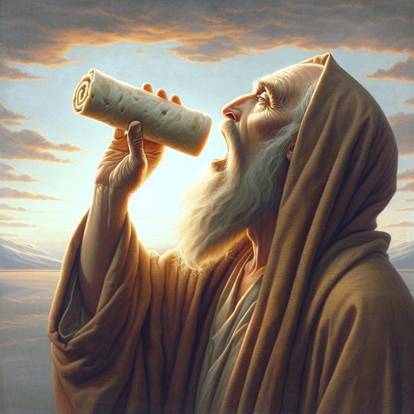
These people then understood Ezekiel’s experience as well, for he too was instructed to eat and teach the word of God to the exiled Israelites in Assyria (Ezekiel 3:1-3). While there is no specific mention about the word becoming bitter in his stomach, we do read that the prophet would experience persecution on account of the word (Ezekiel 3:7). Hence, we may use his example in interpreting Revelation 10:9-11.
Everyone wants to receive revelation from God, for it is sweet to the taste; but not everyone understands that it can also be quite bitter in the stomach. While grace is free, revelation can cost you everything. But thanks be to God, who has continued to provide revelation to His people throughout the generations.

Dr. Stephen Jones has been writing blog posts since 2005 on a variety of topics from Bible Studies to World News, and he has been writing books since 1992. Dr. Jones' most important writings came after God brought him back into the full-time ministry in 1991. It is here that all his earlier years of searching the Scriptures began to come into clear focus. He combines a knowledge of the Old and New Testaments with a personal revelation of God that began and developed during the "wilderness" period of his life, which he often refers to as God's True Bible College... Read More
We are only able to do what we do because of your support. If you feel led to support this ministry, we deeply appreciate it