Latest Posts
View the latest posts in an easy-to-read list format, with filtering options.

View the latest posts in an easy-to-read list format, with filtering options.
Multi-part posts on a particular topic, grouped together in "series" pages.
Look through our blog archive by year / month, or in a massive title list.

03/24/2026 - When President Trump backed down from bombing Iran’s nuclear power plant at Bushehr, under t... Read More
03/23/2026 - After asserting that all unbelievers will have to give account of their actions to the Judge at th... Read More

03/23/2026 - Today President Trump announced that the impending US attack on Iran’s power plants has been... Read More
Read over 100 books written by Dr. Jones, available to read for free online. Several of the books have also been translated into different languages, and are also available to read for free. The only time you pay is when you purchase a physical version of a book.
View Full Book List
Read a variety of tracts that condense a topic into a short, single page format. These tracts can be read for free online, or physical copies can be purchased in bundles. If you are subscribed to the FFI Newsletter, you will receive new tracts when they are released.
View Full Tract List1 Peter 2:1-3 says,
1 Therefore, putting aside all malice and all deceit and hypocrisy and envy and all slander, 2 like newborn babies, long for the pure milk of the word, so that by it you may grow in respect to salvation, 3 if you have tasted the kindness of the Lord.
“Therefore” links this with Peter’s previous statements. This passage continues Peter’s thought from 1 Peter 1:22–25, where he spoke of believers being “born/begotten again… through the living and enduring word of God.” Because the new birth has occurred through the word (gospel), believers, as a natural consequence, are called to grow through the same word.
There is purpose in being begotten by the seed of our heavenly Father. One cannot adopt the common attitude that once I have been “born again” I now have my ticket to heaven and can live life as I please. Peter lists the attitudes of the old life that are incompatible with the new birth. Peter says to “put aside” the old way of life that comes from one’s natural parents—who in turn got this from Adam.
“Put aside” is from the Greek term is ἀποθέμενοι (apothemenoi) — a word used for taking off clothing. The idea is to strip off the garments of the old man and live according to the new self,” or the new nature.
In verse 2 Peter compares this to a newborn baby who longs for the pure milk of the word that allows growth. A newborn, once he/she has “tasted the kindness of the Lord,” craves milk constantly. Peter is urging believers to have the same craving for God's word. This metaphor is founded on the history of the church in the wilderness under Moses, which was fed manna, representing the spiritual flesh of Christ Himself (John 6:51). Unfortunately, many Israelites became tired of manna and complained to Moses. Numbers 11:4-6 says,
4 The rabble who were among them had greedy desires; and also the sons of Israel wept again and said, “Who will give us meat to eat? 5 We remember the fish we used to eat free in Egypt, the cucumbers and the melons and the leeks and the onions and the garlic, 6 but now our appetite is gone. There is nothing at all to look at except this manna.”
This Scripture was written for our learning (Romans 15:4). Even today many in the church show little desire for the word of God. They go to church for other reasons—even good reasons, such as praise and worship, fellowship, communion, entertainment, etc. The problem is that many are bored by the word of God and have made it a low priority.
Some even claim that studying the word of God is a carnal activity. Indeed, if one eats grass (flesh) and fails to chew the cud (meditation), it will not be of much benefit in bringing about spiritual growth. One must learn how to eat clean spiritual food. But how can the Holy Spirit convert grass to spirit without a person first eating this grass?
https://godskingdom.org/search/?query=how+to+eat+clean+spiritual+food&type=audio
Hence, by their neglect—and by despising the word of God—they become part of the “rabble.” For this reason, they have failed to mature into the stature of the fullness of Christ (Ephesians 4:13).
This “milk of the word” is defined more fully in Hebrews 6:1, 2. I expounded on these “elementary teachings” in my book, The Milk of the Word.
https://godskingdom.org/studies/books/the-milk-of-the-word/
1 Peter 2:4, 5 says,
4 And coming to Him as to a living stone which has been rejected by men, but is choice and precious in the sight of God, 5 you also, as living stones, are being built up as a spiritual house for a holy priesthood, to offer up spiritual sacrifices acceptable to God through Jesus Christ.
The temple of Solomon was built upon a dead stone foundation. Any temple made from earthly materials can only be a type and shadow of that which is real. In times past, God instructed men to build physical structures, first Solomon’s temple (1 Kings 5:5) and later the Second Temple (Haggai 1:2). Solomon’s temple had been glorified by the presence of God, but Haggai’s temple did not receive that glory. Why? Because in the interim, the site itself had been cursed by God. We read of this in Jeremiah 7:9-15 and again in Jeremiah 26:6,
6 then I will make this house like Shiloh, and this city I will make a curse to all the nations of the earth.
In other words, the Abrahamic calling (to be a blessing to all nations) will pass from the earthly Jerusalem to the heavenly Jerusalem. The “house of prayer for all the peoples” (Isaiah 56:7) could not fulfill its calling until the greater House was established on the chief Cornerstone, Jesus Christ, and “on the foundation of the apostles and prophets” (Ephesians 2:20-22). This temple is built in the heavenly city that Abraham foresaw (Hebrews 11:10), built in the “better country, that is, a heavenly one” (Hebrews 11:16).
The people wanted to execute Jeremiah for blasphemy against the temple (Jeremiah 26:8, 9), because they did not understand the mind of God. Their minds were carnal, and their trust was in earthly buildings. Jeremiah’s life was spared only because some of the people remembered Micah’s prophecy (Jeremiah 26:16-20) that said the same thing earlier.
The same misunderstanding is rampant even today wherever men promote the belief that a physical temple will again be built on the cursed site in Jerusalem and that Christ will glorify that spot by His presence and be ministered to by Old Covenant priests with animal sacrifices. Those who teach these things have never learned how to eat clean spiritual food. They eat the “grass” through Bible study, but they fail to chew the cud that alone can transform the flesh into spiritual food. Hence, they fail to distinguish between the earthly temple and the “spiritual house” that Peter promoted in verse 5 above.
In 1 Peter 2:5, the apostle shifts from Christ alone to the corporate people of God. Three key identities appear here: (1) Living Stones, where believers share Christ’s life and become part of the structure; (2) A Spiritual House, which refers to God’s temple, but no longer a physical building. Instead, the community of believers becomes God’s dwelling place. (3) A Holy Priesthood. Not only are believers the temple, they are also the priests serving within it.
This combines two Old Testament institutions: Temple and Priesthood. True believers become both, according to their faith in Christ. What will happen with those who have put their faith in a rebuilt temple with the Old Covenant Jewish priesthood? God will have to decide that question.
Instead of animal offerings, believers present praise, worship, obedience, and good works. Hebrews 13:15 calls them “sacrifice of praise.” Romans 12:1 says to “present your bodies a living and holy sacrifice.” Philippians 4:18 speaks of gifts toward the support of the Kingdom as “acceptable sacrifice, well-pleasing to God.”
The questions are these: which temple is the true temple? Which type of sacrifice is acceptable? Which priesthood is qualified to minister to God? Can there be two temples functioning at the same time in the age to come, one for Jews and the other for Gentiles? Was Peter’s temple a temporary innovation during a so-called “age of grace” that ends with the return of Christ?
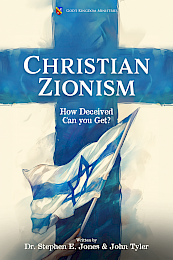
This is currently an ongoing dispute. But Peter’s position is clear. In writing to ex-Israelites of the dispersion, he gave them no hope in an earthly temple. He did not instruct them to return to Judea as Zionists. He insisted that they—as believers in Christ—were living stones in God’s true temple and did not need to rely on a physical temple in Jerusalem.

Dr. Stephen Jones has been writing blog posts since 2005 on a variety of topics from Bible Studies to World News, and he has been writing books since 1992. Dr. Jones' most important writings came after God brought him back into the full-time ministry in 1991. It is here that all his earlier years of searching the Scriptures began to come into clear focus. He combines a knowledge of the Old and New Testaments with a personal revelation of God that began and developed during the "wilderness" period of his life, which he often refers to as God's True Bible College... Read More
We are only able to do what we do because of your support. If you feel led to support this ministry, we deeply appreciate it