Latest Posts
View the latest posts in an easy-to-read list format, with filtering options.

View the latest posts in an easy-to-read list format, with filtering options.
Multi-part posts on a particular topic, grouped together in "series" pages.
Look through our blog archive by year / month, or in a massive title list.

03/28/2026 - This appears to be true. Iran is showing a video of the captured marines. Let’s see if this... Read More
03/28/2026 - ... Read More
03/28/2026 - 1 Peter 5:8, 9 says, 8 Be of sober spirit, be on the alert. Your adversary, the devil, prowls arou... Read More
Read over 100 books written by Dr. Jones, available to read for free online. Several of the books have also been translated into different languages, and are also available to read for free. The only time you pay is when you purchase a physical version of a book.
View Full Book List


Read a variety of tracts that condense a topic into a short, single page format. These tracts can be read for free online, or physical copies can be purchased in bundles. If you are subscribed to the FFI Newsletter, you will receive new tracts when they are released.
View Full Tract List1 Peter 5:8, 9 says,
8 Be of sober spirit, be on the alert. Your adversary, the devil, prowls around like a roaring lion, seeking someone to devour. 9 But resist him, firm in your faith, knowing that the same experiences of suffering are being accomplished by your brethren who are in the world.
Peter gives two admonishments to the ex-Israelites of the dispersion: Be sober (clear-minded, self-controlled) and be alert (watchful, aware). Believers have spiritual and earthly adversaries that must be overcome. “Adversary” (ἀντίδικος) is a legal term: an opponent in a lawsuit or a prosecutor/accuser. This ties closely to Satan as an accuser in the first chapter of Job, as well as in Zechariah 3:1, where Satan accuses Joshua the high priest. The devil is not merely a tempter; he is a legal opponent seeking grounds for accusation.
Peter pictures the devil as a lion, perhaps because both the Babylonians and the Assyrians used the winged lion as their national logo. The Assyrians had been Israel’s primary adversary seven centuries earlier when the sinful Israelite nation had been accused in the divine court. Israel lost its case, due to sin, and so God allowed the lion to devour them.
Lions stalk their prey when they are hungry. By the time a lion roars, it is too late to escape.
A lion seeks to devour, because it is a beast of prey. Hence, when Nebuchadnezzar was given “a beast’s mind” (Daniel 4:16), the king began to manifest the predatory nature of the nation itself, represented by a winged lion, called a lamassu.
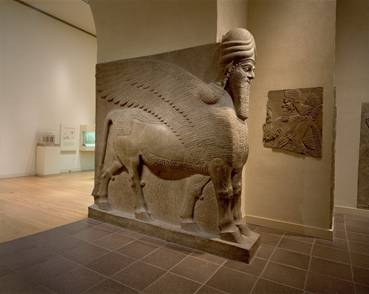
This also applied to Assyria which devoured Israel from 745-721 B.C. Perhaps these ex-Israelites remembered this history and were able to relate to Peter’s metaphor. Peter personalized this principle, showing how each believer was considered to be the prey of a beast empire. In their case, they lived in the time of the Roman beast, the fourth in the succession of empires.
The believers, having inherited the terms of divine judgment against Israel, were to submit to the Roman authorities (1 Peter 2:13-17), but on a personal level, they were to “resist” the adversary. Even so, what form of resistance were they to adopt? It was not to engage in a revolution or in military tactics. They were to resist by being “firm in your faith.” They were to understand that suffering under a beast system was “for your testing” (1 Peter 4:12). Those who might refuse to recognize the beast authority that God had raised up to judge Israel were actually resisting God Himself, because none of the beast empires had any power other than what God had given them.
Suffering injustice and tribulation, then, was an act of faith in itself. Faith puts its trust in the justice of God, even when innocent people suffer injustice at the hands of the beast empire. It recognizes that many generations suffer for the sins of their forefathers and that those who are being judged are required to follow the prophet’s instructions to the captives in Babylon when he wrote them a letter (Jeremiah 29:1). In part, the letter reads (Jeremiah 29:4-7),
4 Thus says the Lord of hosts, the God of Israel, to all the exiles whom I have sent into exile from Jerusalem to Babylon, 5 “Build houses and live in them; and plant gardens and eat their produce. 6 Take wives and become the fathers of sons and daughters… 7 Seek the welfare [shalom, “peace, wholeness, well-being”] of the city where I have sent you into exile, and pray to the Lord on its behalf; for in its welfare you will have welfare’.”
This instruction was sent to the exiles in Babylon, but it carried over into the era of Persia, Greece, and Rome as well. Hence, it applied specifically to the exiles living under the authority of the Roman beast empire. The “lion,” throughout the time of beast domination, has sought to devour those who lacked faith by refusing to follow Jeremiah’s admonition to the exiles.
1 Peter 5:10, 11 says,
10 After you have suffered for a little while, the God of all grace, who called you to His eternal glory in Christ, will Himself perfect, confirm, strengthen, and establish you. 11 To Him be dominion forever and ever. Amen.
The suffering experienced under the beast empires is only “for a little while.” It is temporary, even though it has lasted thousands of years. The fiery tribulation, however, has tested the faith of all believers and has distinguished the overcomers from the rest of the church. Peter looked to the future, when the “dominion” would be transferred to the saints of the Most High, as prophesied in Daniel 7:26, 27,
26 But the [divine] court will sit for judgment, and his dominion will be taken away, annihilated and destroyed forever. 27 Then the sovereignty, the dominion, and the greatness of all the kingdoms under the whole heaven will be given to the people of the saints of the Highest One; His kingdom will be an everlasting kingdom, and all the dominions will serve and obey Him.
This transfer of dominion occurs at the end of the time allotted to the beast empires by the divine court itself. Men can disagree and can try to fight the ruling in the divine court, but men are not sovereign, nor do the beasts reign by the power of their own military and economic strength. Our sovereign God overrules all the plans of men according to the counsel of His own will.
While Jesus Christ is the King and the rightful Heir of this final Kingdom, He will not reign by Himself. The faithful ones, the overcomers, those not devoured by the lion (devil), “will be priests of God and of Christ and will reign with Him for a thousand years” (Revelation 20:6). The dominion will be “given to the people of the saints of the Highest One.” For this reason, John saw not only a throne but “thrones, and they sat on them and judgment was given to them” (Revelation 20:4).
This echoes the scene in Daniel 7:9,
9 I kept looking until thrones were set up, and the Ancient of Days took His seat…
The KJV reads (incorrectly), “till the thrones were cast down.” Daniel was not referring to the thrones of the beast empires being “cast down,” but to the thrones of the overcomers being established. This is confirmed by John himself.
We today are finally approaching the end of the final beast empire, and the transfer of authority has already been decreed in the divine court. We now await the rise of prophetic “Cyrus” (Isaiah 45:1) and Persia, which God has raised up to free the world of beast domination. The original Cyrus played a dual role: (1) a messiah of Isaiah 45:1, and (2) the bear-like beast of Daniel 7:5. The original Cyrus set the people partially free by his edict, but his calling as the bear was dominant for the next two centuries.
In today’s world, modern Persia (Iran) is again being raised up to overthrow the dominion of Mystery Babylon. Persia’s role as a bear has run its course, and so its role as a type of messiah is now dominant. For this reason, the hidden rulers of “Mystery” Babylon are fighting a losing battle. God has hardened their hearts in order to bring them to a “Red Sea” moment.
1 Peter 5:12-14 says,
12 Through Silvanus, our faithful brother (for so I regard him), I have written to you briefly, exhorting and testifying that this is the true grace of God. Stand firm in it! 13 She who is in Babylon, chosen together with you, sends you greetings, and so does my son, Mark. 14 Greet one another with a kiss of love. Peace be to you all who are in Christ.
It appears that Peter dictated his letter to Silvanus with the help of John Mark, the nephew of Barnabas, much like Paul’s letters were penned by Luke. This letter was written from Babylon—not the famous city on the Euphrates River, nor from Rome (as some would have it), but from a Roman military garrison south of Alexandria in Egypt that was also called Babylon. There was a church there, apparently in the house of a woman whose name Peter withheld for her own protection.
It was there that the original copies of the four gospels were found more than a century ago (1906). These are now referred to as Codex Washingtonensis, or Codex W. They are now in the Smithsonian Institute.
These original gospels were transcribed by Barnabas and Mark, each with their own handwriting, and each gospel was initialed by the original author. For more details, go to chapter 24 of Lessons from Church History, Vol. 1.

Dr. Stephen Jones has been writing blog posts since 2005 on a variety of topics from Bible Studies to World News, and he has been writing books since 1992. Dr. Jones' most important writings came after God brought him back into the full-time ministry in 1991. It is here that all his earlier years of searching the Scriptures began to come into clear focus. He combines a knowledge of the Old and New Testaments with a personal revelation of God that began and developed during the "wilderness" period of his life, which he often refers to as God's True Bible College... Read More
We are only able to do what we do because of your support. If you feel led to support this ministry, we deeply appreciate it