Latest Posts
View the latest posts in an easy-to-read list format, with filtering options.
View the latest posts in an easy-to-read list format, with filtering options.
Multi-part posts on a particular topic, grouped together in "series" pages.
Look through our blog archive by year / month, or in a massive title list.

03/31/2026 - We will leave here tomorrow morning to go to the weekend Passover conference in Chattanooga, TN, a... Read More

03/30/2026 - The latest biblical commentaries Ecclesiastes: The Philosophical Preacher, and Philippians, Philem... Read More

03/30/2026 - ... Read More
Read over 100 books written by Dr. Jones, available to read for free online. Several of the books have also been translated into different languages, and are also available to read for free. The only time you pay is when you purchase a physical version of a book.
View Full Book List
Read a variety of tracts that condense a topic into a short, single page format. These tracts can be read for free online, or physical copies can be purchased in bundles. If you are subscribed to the FFI Newsletter, you will receive new tracts when they are released.
View Full Tract ListNahum 2:8 says,
8 Though Nineveh was like a pool of water throughout her days [min yom, “from (its) days,” or “from of old”], now they are fleeing. “Stop, stop,” but no one turns back.
The phrase min yom is difficult to translate, and scholars differ in their opinions. Yet the picture is of a reservoir of water whose wall has been broken, allowing the water to drain away. Translators connect the image of a pool of water with the fleeing of the inhabitants, creating the metaphor: "Nineveh is like a pool... whose waters (people) are fleeing."
The NIV reads, "Nineveh is like a pool and its water is draining away." The “pool” today is more of a swamp, and God is draining the swamp.
The Hebrew structure emphasizes contrast: Nineveh, once stable like a pool, is now in panic — the inhabitants flee despite commands to stop. This represents a vain attempt to stop the panic. The leaders or commanders are shouting to restore order or to regroup their forces, but no one listens. The fear and sense of doom are so overwhelming that discipline breaks down, and everyone is focused solely on escaping.
It underscores the irreversibility of Nineveh's fall — it’s not just a military defeat but a complete collapse of morale and order.
Nahum 2:9, 10 continues,
9 Plunder the silver! Plunder the gold! For there is no limit to the treasure—wealth from every kind of desirable object. 10 She is emptied! Yes, she is desolate and waste! Hearts are melting and knees knocking! Also anguish is in the whole body.
This verse is mocking and ironic. Nineveh was once a storehouse of wealth because it had pillaged other nations and cities (Nahum 3:1). But now it is being looted in return. The plunderer is being plundered. One might call it “the great wealth transfer.” On a prophetic level, this suggests that the fall of Babylon/Nineveh is not only about people changing their citizenship from one nation to another but is also about an economic disaster.
The world system today is powered by its financial system of debt-money banking. Nahum’s prophecy suggests a great financial collapse or, perhaps, replacing it with something else. By mentioning both silver and gold in the same context, it might mean that our current fiat money system will be replaced by currencies backed by silver and gold.
Nahum pictures an atmosphere of fear. The idea that “hearts are melting and knees knocking” may point to the time when the old city of Babylon fell. During Belshazzar’s party, a hand was seen writing a message on the wall, and the king’s “knees began knocking together” (Daniel 5:6). News reports today indicate that top bankers already see the handwriting on the wall, so to speak, and are now in a state of panic, knowing that the end of their current financial system is near.
Nonetheless, we need to remind ourselves that God is not merely destroying the old system that has kept nations in debt-bondage for so long. He is building His Kingdom, which includes a new financial system where currency is an asset, not a debt-note. The present system is falling because God is liberating the world from its satanic slave-owners.
Those who know not the divine plan are subject to fear; those who know His plan walk by faith. As children of the Most High, we read in Psalm 91:8-12,
8 You will only look on with your eyes and see the recompense of the wicked. 9 For you have made the Lord, my refuge, even the Most High, your dwelling place [abiding in Him]. 10 No evil will befall you, nor will any plague come near your tent. 11 For He will give His angels charge concerning you, to guard you in all your ways. 12 They will bear you up in their hands, that you do not strike your foot against a stone.
Our outlook on life is a combination of fear and faith. The more fear we have, the less faith we have. More faith, less fear. God is our “refuge” and “dwelling place.” This is the “dwelling place” (or “mansions,” KJV) that Jesus has prepared for us (John 14:2). It is not a big house in heaven, but an earthly relationship with Christ.
The Greek word is mone, “a dwelling place.” The verb form is meno, “to abide.” So Jesus told His disciples to “abide in Me, and I in you” (John 15:4). We indwell Him, and He indwells us.
This is the only way a “branch” can bear fruit, He says. Jesus says again in John 15:7, 8,
7 If you abide in Me, and My words abide in you, ask whatever you wish, and it will be done for you. 8 My Father is glorified by this, that you bear much fruit, and so prove to be My disciples.
Ninevites do not enjoy such a relationship with Christ, and so they remain in a state of panic and fear. But we know that we are temples of God (1 Corinthians 3:16), in which He “abides.”
Nahum 2:11, 12 then compares Nineveh to a den of lions, saying,
11 Where is the den of the lions and the feeding place of the young lions, where the lion, lioness, and lion’s cub prowled, with nothing to disturb them? 12 The lion tore enough for his cubs, killed enough for his lionesses, and filled his lairs with prey and his dens with torn flesh.
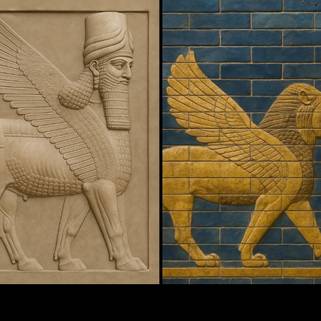
This is another way of telling us that the Nineveh, the plunderer, is now to be plundered. In Assyrian art and architecture, the most famous winged creatures are the lamassu: colossal guardian figures with the body of a bull or lion, wings of an eagle, and the head of a human. These flanked gateways at Nineveh, Nimrud, and other Assyrian capitals.
Though lamassu often have a bull’s body, there are examples with lion bodies as well. Hence, the Assyrians employed winged lions—but usually as protective spirits, warding off evil at palace entrances. They symbolized royal power, divine protection, and cosmic order.
In Babylon, the lion was central (especially tied to Ishtar) (called a griffin) and though usually shown without wings, winged lion/griffin motifs existed in art. Daniel 7:4 describes Babylon as a lion with eagle’s wings. That imagery would have resonated with both Babylonian and Assyrian cultural motifs. Below, an Assyrian lamassu is on the left, and the Babylonian griffin is on the right.
Prophetically speaking, Nineveh and Babylon both represent the hidden, secret, or “mystery” Babylon that was to rule the world prior to the coming of the Kingdom. In the New Testament, 1 Peter 5:8 relates this lion to the devil,
8 Be of sober spirit, be on the alert. Your adversary, the devil, prowls around like a roaring lion, seeking someone to devour.
Nahum 2:12 pictures this perfectly in applying it to Nineveh and (by extension) to Babylon.
Nahum 2:13 concludes,
13 “behold, I am against you,” declares the Lord of hosts. “I will burn up her chariots in smoke, a sword will devour your young lions; I will cut off your prey from the land and no longer will the voice of your messengers be heard.”
This prophesies of the demilitarization of prophetic Nineveh/Babylon, which is what we are now witnessing on account of the Russia-Ukraine war. Western military provisions are being destroyed on the battlefield at an alarming rate. American munitions are being used up in the Zionist state and (in June 2025) were also destroyed by Iranian missiles.
The lion of Nineveh/Babylon is being starved to death, because God is cutting off their “prey.” The more they impoverish the people through debt, the less “prey” they have.

Dr. Stephen Jones has been writing blog posts since 2005 on a variety of topics from Bible Studies to World News, and he has been writing books since 1992. Dr. Jones' most important writings came after God brought him back into the full-time ministry in 1991. It is here that all his earlier years of searching the Scriptures began to come into clear focus. He combines a knowledge of the Old and New Testaments with a personal revelation of God that began and developed during the "wilderness" period of his life, which he often refers to as God's True Bible College... Read More
We are only able to do what we do because of your support. If you feel led to support this ministry, we deeply appreciate it